
How to Outsource Software Development from the UK to Pakistan (2026 Guide)
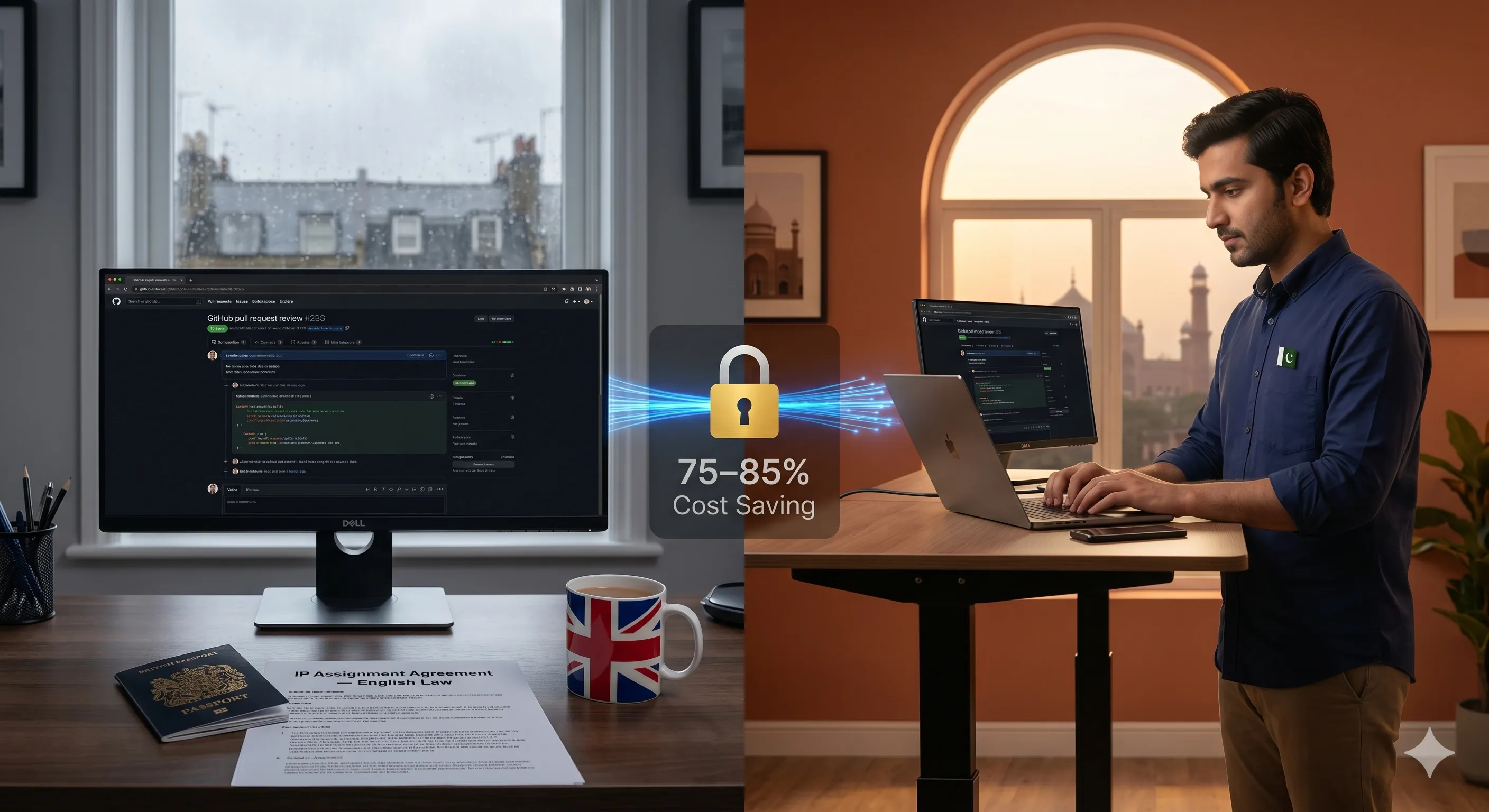
Table Of Content
Outsourcing software development from the UK to Pakistan reduces development costs by 75–85% compared to UK agency rates. Pakistan has over 300,000 active software professionals, 17,000+ PSEB-registered IT companies, and a strong English-language tech workforce. UK companies can expect hourly rates of $15–$35 from experienced Pakistan teams, versus $100–$150 from UK agencies for equivalent seniority.
UK development budgets don't go far. A senior developer at a London agency costs £600–£850 per day. A 3-person team on a 16-week project costs £100,000–£175,000 before design, QA, or infrastructure. For most UK startups and SMEs, that is the entire annual technology budget.
Pakistan-based development companies — the serious ones, not the cheapest-on-Upwork — deliver to the same specification for £12,000–£30,000 on the same project. The engineering talent is comparable. The communication tools are identical. The intellectual property is yours. The difference is entirely in developer day rates. ZeeBrains, for example, has delivered production systems including Stockly — an AI-powered trading platform — and Algomnia, a market analysis system, for UK clients at a fraction of London agency rates.
This guide covers everything a UK business needs to know before making that decision: why Pakistan specifically, how to find and vet the right company, what contracts to insist on, how to manage the time zone, and what onboarding looks like in practice.
Why Pakistan, Specifically?
There are several offshore development destinations available to UK companies: India, Ukraine, Poland, Egypt, Vietnam. Pakistan has quietly become one of the strongest options.
- Scale and talent depth: Pakistan has over 300,000 active software professionals and more than 500,000 IT graduates entering the workforce annually. The Pakistan Software Export Board (PSEB) counts over 17,000 registered IT and ITeS companies.
- English proficiency: Pakistan's formal education system has used English as the primary medium of instruction for decades. University engineering programmes are conducted in English. Most software professionals communicate in fluent English.
- Cost reality: Pakistan developers charge $15–$35/hr for experienced engineers. UK developer equivalent rates are $100–$150/hr. That is a 75–85% reduction on a £100,000 UK project.
- IT export growth: Pakistan's IT exports reached $3 billion in FY 2023–24, growing at 20–25% annually — with government policy specifically prioritising export-quality delivery to Western markets.
- UK market familiarity: Pakistan's software industry has worked with UK clients specifically for more than two decades. Familiarity with UK business culture, GDPR, FCA, and NHS Digital standards is higher than in comparable markets.
What UK Companies Actually Save: Real Numbers
- Senior developer: UK £600–£850/day vs Pakistan £90–£150/day
- Mid-level developer: UK £400–£600/day vs Pakistan £60–£100/day
- UI/UX designer: UK £450–£700/day vs Pakistan £50–£90/day
- QA engineer: UK £350–£500/day vs Pakistan £45–£75/day
- Project manager: UK £400–£650/day vs Pakistan £60–£95/day
On a typical customer-facing web application (3-person team, 14 weeks): UK agency total: £90,000–£145,000. Pakistan delivery total: £14,000–£26,000. Saving: £64,000–£119,000 on a single project.
For context on what these budgets build, see our complete guide to custom software development costs in the UK.
How to Find a Reliable Pakistan Software Company: The Honest Process
This is where most UK buyers go wrong. The wrong sourcing strategy leads to the wrong shortlist.
Where not to source:
- Upwork/Fiverr for full projects: appropriate for freelance tasks, not managed development projects. The lowest-bid dynamic selects for exactly the wrong outcome.
- Generic Google searches for "cheap software development Pakistan": the companies spending the most on ads are not always delivering the best work.
Where to source:
- Clutch.co: the most trusted B2B tech directory. Pakistan companies with 4.8+ ratings and verified UK client reviews are a credible starting shortlist. Read reviews carefully — look for UK-specific mentions.
- GoodFirms: second-tier Clutch alternative with strong Pakistan company listings.
- Direct referrals: the UK startup community (accelerators, founder groups, LinkedIn) is the best source of warm referrals from founders who have outsourced.
- LinkedIn search: search "software development company Pakistan" and filter for companies with UK-facing client portfolios.
What to check before putting a company on your shortlist:
- Minimum 3 years in operation
- At least 5 verifiable reviews on Clutch or Google from UK or USA clients
- Portfolio includes work in your sector or adjacent sectors
- English-language case studies with concrete outcomes
- Named technical leadership visible on the website
How to Vet a Pakistan Development Company: The 8-Point Checklist
- Request a technical discovery call. Ask: "Walk me through the architecture of a recent project similar to mine." This separates companies that build properly from those that just execute instructions.
- Ask for two reference calls — not written references. A 15-minute call with a real past client cannot be faked. Any credible company will facilitate this.
- Review their team composition. Ask: "Who specifically would work on my project?" Get names and LinkedIn profiles. Verify seniority claims.
- Test their communication in a paid discovery phase. Run a paid discovery (£1,000–£3,000) before committing to a full build. This tests real communication quality and delivery consistency.
- Check their GitHub or request code samples. Any serious development company has open-source contributions or will share sanitised code samples on request.
- Confirm their development process. You want: Agile or Scrum sprints, weekly demos, Jira or equivalent task tracking, GitHub with proper branch management, documented QA process.
- Ask about time zone overlap. Pakistan is UTC+5. UK is UTC+0/+1. Ask how they run daily stand-ups with UK clients and what their response time commitment is outside overlap hours.
- Request their standard contract for review. Do not sign anything before a UK-qualified lawyer has reviewed the IP assignment and data processing clauses.
Contracts: What UK Buyers Must Insist On
This is the section most outsourcing guides skip or handle superficially. UK businesses have specific legal obligations that must be addressed in any development contract with an offshore company.
- IP Assignment (Non-Negotiable): The contract must explicitly state that all code, designs, documentation, and derivative works are assigned to your company upon creation. You need an explicit IP assignment clause under English law — not just "work for hire."
- NDA Scope: The NDA should specifically cover source code, system architecture, user data, business logic, API keys, and any personally identifiable information shared during requirements sessions.
- Governing Law: For UK companies, insist on English law as the governing law and the courts of England and Wales as the jurisdiction for disputes.
- GDPR and Data Processing Agreement: If your software handles personal data of UK individuals, your development company is acting as a data processor under UK GDPR. You are required to have a signed Data Processing Agreement (DPA) in place before sharing any personal data.
- Source Code in Escrow: For projects over £30,000, consider placing source code in a third-party escrow service. Most UK-experienced agencies will agree to this without issue.
Managing the Time Zone: What Actually Works
The 4–5 hour overlap window is sufficient for effective project management if structured deliberately.
What works:
- Daily stand-up at 9 AM UK time (2 PM Pakistan time) — the primary synchronisation point
- All sprint planning, architecture reviews, and demos scheduled during overlap hours
- Asynchronous updates via Slack and Jira for the rest of the day
- Sprint retrospectives every 2 weeks on a video call
- Weekly written progress summary from the PM delivered before end of UK day Friday
What doesn't work:
- Expecting real-time response during UK afternoons — messages sent after 1 PM UK will be answered the following morning
- Ad-hoc calls without scheduling — book everything in advance
- Daily stand-ups at 3 PM UK — that is 8 PM Pakistan
What Onboarding Looks Like After You Sign
- Week 1 — Environment setup: Repository access, development environment, staging server, CI/CD pipeline, task management setup. The development company should handle this; you review and approve.
- Weeks 1–2 — Discovery sprint: Even with a well-written brief, a paid discovery sprint is worth running. User stories are validated, architecture decisions are finalised, integrations are confirmed, ambiguities resolved in writing.
- Weeks 2–3 — Foundation layer: Development of the core data model, authentication system, and primary navigation structure. No visible features yet — this is the foundation everything else builds on.
- Week 3 onwards — Feature sprints: Regular 2-week sprints, each ending in a working demo. You review, give feedback, the team incorporates it in the next sprint.
If your development company is not running sprint demos — insist on them. Demos are how you catch scope creep, quality issues, and misunderstood requirements before they become expensive problems.
Common Mistakes UK Buyers Make When Outsourcing to Pakistan
- Choosing on price alone: The cheapest Pakistan developer is not the most cost-effective. A £5/hr developer who requires 3x the hours costs more than a £20/hr developer who delivers properly.
- Not running a paid discovery phase: Going straight from brief to development is the leading cause of over-budget, over-time projects regardless of where your team is based.
- Skipping the reference call: The reference call is the most important part of vetting. Do not skip it.
- Vague IP contracts: IP assignment must be explicit, cover derivative works, and be reviewed by a UK lawyer.
- Treating it like a supplier, not a team: The most successful outsourcing relationships operate as integrated teams. Involve your development company in product decisions. Share context.
- Not budgeting for a project manager: Running a development team without clear ownership on the client side is a common cause of project failure.
For more on evaluating development partners, read our guide to hiring a mobile app development company without getting burned — the vetting principles apply equally to custom software companies.
Frequently Asked Questions
Is Pakistan a good country for software development outsourcing?
Yes. Pakistan has over 300,000 active software professionals, a strong English-speaking tech workforce, and IT exports growing at 20–25% annually. UK companies benefit from Pakistan's long history of serving Western clients and familiarity with UK regulatory norms including GDPR.
How do I protect my IP when outsourcing to Pakistan?
Use an explicit IP assignment agreement under English law. All code, designs, and documentation must be assigned to you upon creation. Specify English courts as the governing jurisdiction. Have all contracts reviewed by a UK-qualified solicitor. For high-value projects, use a source code escrow service.
What is the time zone difference between the UK and Pakistan?
Pakistan is UTC+5 — 4 hours ahead of the UK in winter, 5 hours ahead in summer (when UK is on BST). A 9 AM daily stand-up in the UK is 2 PM in Pakistan, which is the standard rhythm for UK–Pakistan development teams.
What GDPR obligations apply when outsourcing to Pakistan?
If your software processes personal data of UK individuals, your Pakistan development company is acting as a data processor under UK GDPR. You must have a signed Data Processing Agreement (DPA) in place before sharing any personal data. Any reputable Pakistan agency with UK client experience will have a standard DPA available.
How much does it cost to outsource software development to Pakistan?
Pakistan development companies charge $15–$35/hr for experienced engineers versus $100–$150/hr for UK equivalents. A typical customer-facing web application costing £90,000–£145,000 at a UK agency typically runs £14,000–£26,000 delivered from Pakistan. See our full breakdown in the custom software development cost UK guide.
How do I manage a Pakistan development team remotely?
Use Agile sprints (2-week cycles) with a daily stand-up at 9 AM UK time, weekly written updates, and end-of-sprint demos. Jira for task management, GitHub for code, Slack for communication. The overlap window (9 AM–1 PM UK) is sufficient for synchronous work. All major decisions should happen during overlap hours.
What should be in the contract when outsourcing to Pakistan?
At minimum: explicit IP assignment under English law, NDA covering code and architecture, UK GDPR Data Processing Agreement, governing law clause specifying England and Wales, payment milestones tied to sprint deliverables, and a termination clause including handover of all source code. See our custom software development services page for how we structure UK client engagements.
Written by
Zee Brains
Team
Passionate about building innovative digital solutions and sharing insights with the tech community.