
MVP App Development: How UK Startups Go from Idea to Launch in 90 Days
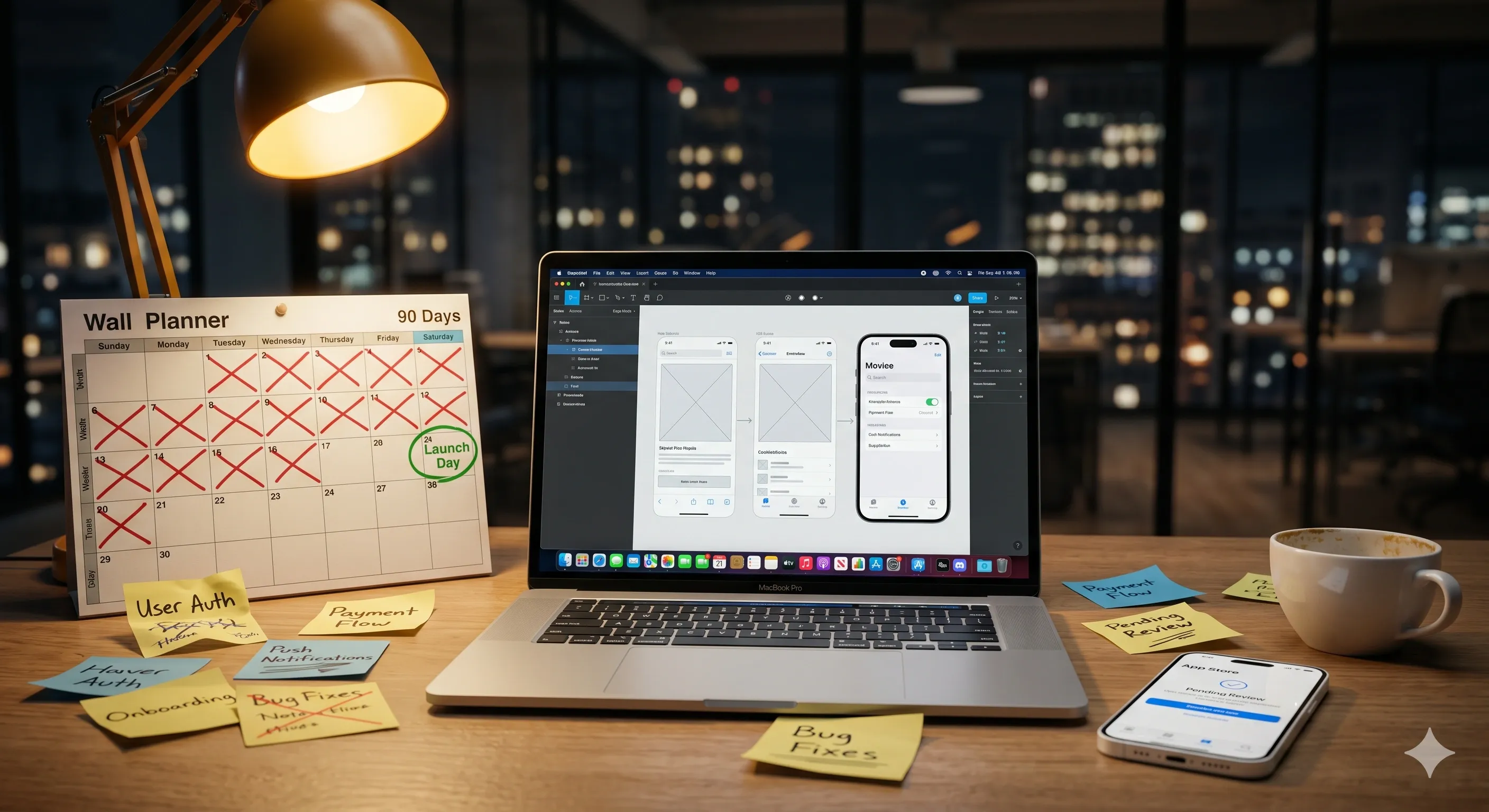
Table Of Content
An MVP (Minimum Viable Product) app is the smallest version of your product that delivers enough value for real users to test, use, and pay for. For UK startups in 2026, a focused mobile app MVP takes 8–14 weeks and costs £10,000–£40,000. The goal is not a finished product — it is validated learning before full investment.
MVP App Development: How UK Startups Go from Idea to Launch in 90 Days
Most UK startup founders wait too long to launch. They spend six to twelve months refining an idea they think is right, build a product they believe users will love, and release it to discover the market wants something different — or nothing at all.
The MVP process exists specifically to prevent that outcome. This guide covers what an MVP is, how to scope one, how to build and launch it in 90 days, how to fund it through UK-specific channels, and what to do with what you learn. If you are still evaluating which technology stack to use, our Flutter vs React Native guide covers the most common mobile framework decision UK startups face in 2026.
What an MVP Is — and What It Is Not
An MVP is the smallest possible version of your product that allows real users to experience the core value and provide genuine feedback. It is not a prototype, a demo, or a half-built app. It must be functional enough to use, and specific enough to test one clear hypothesis. For cost benchmarks before you start scoping, read our mobile app development cost guide for the UK.
An MVP is:
- A working product that solves one specific problem for one specific type of user
- Functional enough for real users to complete the core task
- Measurable against a defined success metric
- Shippable within weeks, not months
An MVP is NOT:
- A wireframe or clickable prototype
- A ‘version one’ with every feature planned
- A proof of concept for investors that no real user will touch
- An excuse to ship something broken
The distinction matters because many UK startups confuse building a prototype with building an MVP. A prototype tests a design concept. An MVP tests a business hypothesis with real users in the real market.
The Two Types of MVP for UK Startups
Low-fidelity MVPs test the concept before writing any code. A landing page with a waitlist sign-up, a manual process run behind the scenes, or a concierge service where you deliver the product by hand — all of these can validate demand without development cost. Before spending £15,000 on a developer, spend £500 on a landing page and see if anyone signs up.
High-fidelity MVPs are working software products — functional apps with real data, real users, and real transactions. The rest of this guide focuses on high-fidelity mobile app MVPs.
The 90-Day MVP Sprint Roadmap
A 90-day MVP launch breaks into four phases: (1) Discovery and scope, weeks 1–2; (2) Design and prototype, weeks 3–5; (3) Development sprints, weeks 6–10; (4) QA, beta, and launch, weeks 11–13. Each phase has defined outputs that gate the next. Skipping any phase adds risk, not speed.
Weeks 1–2: Discovery and Scope Definition
This is where most MVPs succeed or fail before a line of code is written.
Define the core problem in one sentence. Not ‘we help businesses manage their workflow’ — that is a category. ‘We help sole-trader electricians send invoices from their phone before leaving the job site’ is a testable hypothesis.
Apply MoSCoW prioritisation to every feature:
- Must have: features without which the app cannot perform its core function
- Should have: features that significantly improve the experience but are not essential for launch
- Could have: nice-to-haves that add value but do not block the MVP
- Won’t have (for now): everything else — defer ruthlessly
The output of weeks 1–2: a one-page scope document, a feature list with MoSCoW ratings, a defined success metric, and a fixed-price quote from your development partner.
Weeks 3–5: Design and Prototype
UI/UX design for an MVP is not about aesthetics. It is about clarity. A user who cannot understand your app in the first 30 seconds will not give you the feedback you need.
Your designer should produce:
- User flow maps showing every screen from first open to core task completion
- Wireframes for every screen in the MVP scope
- A clickable prototype for user testing before development begins
User test the prototype with 5–10 real target users before writing a single line of code. Watch what confuses them. This feedback costs nothing to act on at the design stage.
Output of weeks 3–5: a tested prototype, finalised screen designs, and developer-ready specifications.
Weeks 6–10: Development Sprints
Development runs in two-week sprints, each with a defined backlog, daily standup, and sprint review where working software is demonstrated.
- Sprint 1 (Weeks 6–7): Core architecture, user authentication, database structure, basic navigation
- Sprint 2 (Weeks 7–8): Core feature set — the single thing the app must do
- Sprint 3 (Weeks 9–10): Secondary features, third-party integrations, error handling
In 2026, AI-assisted dev tools — Cursor, GitHub Copilot — have compressed timelines meaningfully. A focused MVP can now realistically hit 10–12 weeks where 14–18 was the norm three years ago. We build cross-platform MVPs using Flutter by default — read our framework comparison to understand why.
Output of weeks 6–10: a functional build covering all must-have features, ready for QA.
Weeks 11–13: QA, Beta Testing, and Launch
A broken MVP teaches the wrong lessons — users abandon because of bugs, not because your idea is wrong.
- Run a closed beta with 20–50 real users from your target audience
- Observe how they use the product, not just what they say
- Measure your pre-defined success metric — not downloads, but the behaviour that validates your hypothesis
- Fix critical bugs, then ship — do not wait for perfection
Output of weeks 11–13: a live app in the App Store and Google Play, 20–50 active beta users, and your first real data set.
How to Scope an MVP Feature List Properly
The most valuable exercise before development begins is writing a user story for your core feature:
‘As a [specific user], I want to [do this thing] so that [this outcome happens].’
Then ask: what is the minimum the app needs to do for this story to be true? That is your MVP feature.
Example: ‘As a sole-trader electrician, I want to photograph a completed job and generate an invoice from my phone so that I am paid before I drive to the next job.’
The minimum the app needs: camera access, a simple invoice template, PDF generation, email send. Not a customer portal. Not recurring billing. Those are version two.
What Does an MVP App Cost in the UK in 2026?
See our full mobile app development cost guide for a complete breakdown. Summary by MVP type:
Simple single-feature MVP — UK Agency: £10k–20k | Offshore (Pakistan): £5k–10k | Timeline: 6–8 weeks
Standard mobile MVP — UK Agency: £20k–40k | Offshore: £10k–20k | Timeline: 8–12 weeks
MVP with backend/API — UK Agency: £35k–65k | Offshore: £15k–30k | Timeline: 10–16 weeks
Two-sided marketplace — UK Agency: £50k–90k | Offshore: £25k–45k | Timeline: 14–20 weeks
UK startups increasingly use offshore partners for MVP builds. The budget saving is often the difference between building and not building. For how we scope and price mobile app development projects, including MVPs, see our service page. See our logistics dispatch app case study for how the 90-day approach worked on a real UK project.
UK Funding Sources for MVP Development
Most MVP guides ignore the UK funding ecosystem. Here are the options worth knowing:
- Innovate UK Smart Grants — Funds up to £500,000 in R&D project costs at 70% for SMEs. A well-scoped MVP with market validation evidence is exactly what they fund. Check current rounds at gov.uk/government/organisations/innovate-uk.
- SEIS and EIS Tax Relief — SEIS gives investors 50% income tax relief on investments up to £200,000. EIS gives 30% relief up to £1 million. If you are raising to build your MVP, structuring through SEIS/EIS makes your round more attractive to UK angels.
- Start Up Loans — The British Business Bank’s programme offers £500–£25,000 at 6% fixed interest with free mentoring. No equity given away.
- Accelerator Programmes — Entrepreneur First, Founders Factory, and Techstars London provide funding and technical resource. Many eliminate MVP development cost entirely.
How to Measure MVP Success: Pivot, Persevere, or Kill
After launch, measure one metric that directly indicates whether users get value: activation rate, week-2 retention, or willingness to pay. Define this metric before you launch, not after.
- Activation rate — What percentage of users complete the core action? Below 40% means the core UX needs fixing before anything else.
- Week-2 retention — What percentage of users returned 7 days after completing the core action? Below 20% means users do not find enough value to return.
- Willingness to pay — Did any user pay, attempt to pay, or explicitly say they would pay? For a free beta, test with a ‘purchase’ button that tracks clicks.
Persevere: activation >40%, week-2 retention >20%, at least one paying user or strong intent signal. Build the next feature set.
Pivot: users engage but not with the feature you built. Follow their behaviour, not your original plan.
Kill: users sign up, open once, never return — across multiple cohorts. The most valuable outcome of an MVP is discovering this before spending £150,000.
Outsourcing Your MVP: What to Look For
For UK startups without in-house technical resource, outsourcing is the only path. For an MVP, speed and communication matter more than long-term maintenance experience.
- Willingness to do discovery first — Any partner who quotes a build price without understanding your users is guessing. That guess becomes your budget.
- Fixed-price MVP contracts — MVPs should be scoped as fixed deliverables, not time-and-materials. An open-ended T&M contract on an MVP has no ceiling.
- Experience with your app category — An agency that has built marketplace apps understands two-sided complexity. Ask for relevant examples.
- Sprint-based delivery with working software each fortnight — If you are not seeing working software every two weeks, the project is not on track.
ZeeBrains builds mobile app MVPs using Flutter, with fixed-price scoping and fortnightly sprint reviews. See our mobile app development service for how we scope and price MVP projects, or visit our guide to hiring a mobile app development company to understand what to look for when evaluating any development partner.
Why UK Startups Work With Offshore Teams for MVPs
A UK agency charges £60–£100/hour. A 12-week MVP at three developers is £86,000–£144,000. Most UK startups cannot absorb that before raising a seed round. Pakistan-based teams offer £20–£40/hour for equivalent technical skill — the same build comes to £28,000–£57,000. If you also need custom software development beyond a mobile app, the offshore model compounds the saving further.
Frequently Asked Questions
Q: How long does it take to build an MVP app in the UK in 2026?
A: A focused mobile app MVP takes 8–14 weeks from start of development, plus 2–4 weeks for discovery and design. End-to-end: 12–18 weeks. Read our full mobile app development cost guide for context on what drives timeline variation.
Q: Should I build an iOS or Android MVP first?
A: For UK consumer apps, iOS first is conventional — iPhone users have higher average spend. For B2B or lower-income demographics, Android’s wider UK share makes it stronger. Cross-platform frameworks like Flutter let you build both at 30–40% less than two native builds.
Q: What is the difference between an MVP and a prototype?
A: A prototype is a clickable mockup used to test design concepts. An MVP is working software real users can complete a real task with. An MVP can be transacted on, iterated, and measured. A prototype cannot.
Q: Can I get funding to build an MVP in the UK?
A: Yes. Innovate UK Smart Grants fund up to 70% of qualifying R&D project costs for SMEs. The Start Up Loans programme offers £500–£25,000 at 6% interest. SEIS/EIS make raising from UK angels significantly more investor-friendly.
Q: When should I stop building the MVP and start building the full product?
A: When activation >40%, week-2 retention >20%, and users are paying or expressing clear willingness to pay. Move on data, not instinct.
Q: Is there anything else I should consider before building?
A: Yes — if your product involves transactions, supply chain data, or credential verification, it may be worth reading our guide on whether your business actually needs blockchain before committing to a conventional architecture.
Written by
ZeeBrains Editorial Team
Software Development
Passionate about building innovative digital solutions and sharing insights with the tech community.